


 Home Page
 English (1.186)
 Library (18)

 From Market Research to Market Monitoring
Do you prefer a Photo or a Movie?
 It is quite common to hear statements like this: "market research is a photograph taken in the rear-view mirror, from inside a moving car". This comparison of a company with a moving vehicle seems valid: when the company, which is moving, commissions market research, it only receives the results after a certain time. When these results are finally available, they effectively portray a market moment that is already in the past.
This is why some companies repeat their market research periodically, usually every year. Over the course of a year, however, the market can undergo many significant changes, which will not be noticed until after the new results are obtained. That is why nowadays it is preferable to migrate to the market monitoring model , where instead of an annual photograph, we can obtain market portraits at much shorter intervals. This sequence of images is comparable to a movie, which is simply a sequence of images at high speed.
Monitoring or Research: what’s the difference?
Just like traditional market research, market monitoring follows all the recommendations in statistical manuals, in order to guarantee the representativeness of the results generated. Therefore, determining the sample size, taking into account the size of the study universe and the desired (or acceptable) margin of error remains essential.
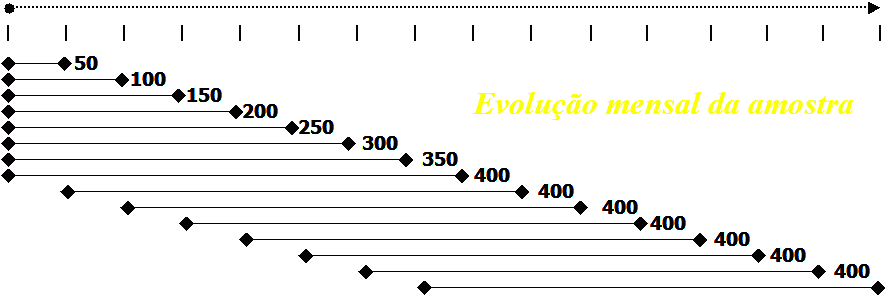
The main difference is planning the information gathering process so that it can be worked on in small consecutive batches (typically, one batch each month). With the continuous repetition of this tactic, it is possible to obtain results for the last six months (for example), every month, and thus build a serious history.
The size of the lots, their frequency and the size of the market observation “window” must be adjusted to each specific market. Furthermore, at the beginning of the work it is possible to build a larger initial batch, so that the first results can be obtained more quickly.
The fundamental issue for the success of this strategy is the ability to control the information gathering and analysis processes.
How to use Monitoring results
As the continuous production of information about specific markets is still uncommon, companies that have this type of information can use it as a differentiator. In addition to the obvious internal use for making decisions more adjusted to the reality of the evolving market, part of what is called market intelligence , the information generated can be used in various ways:
Contents for the media
Journalists from all media outlets are eager for objective information about all types of markets. When a company provides this ready-made information to the media, the chance of having its name mentioned is much greater than in the case of traditional press releases, which generally focus on launching products/upgrades and/or customer success stories.
We observed that: a) the total cost of market monitoring plus hiring a press office is lower than that of the vast majority of advertising campaigns. However, the editorial coverage that the company receives results in a much greater gain in credibility than advertisements; b) editorial coverage does not have the 'vice' of generating distrust among readers when it is discontinued (an effect that commonly occurs when discontinuing an advertising campaign - when the reader gets used to seeing an advertisement systematically and it stops being published, implicitly distrust is created in the company's ability to continue financing its advertisements).
Contents for customers and prospects
The results of market monitoring can also be used in communicating with the company's customers and prospects in other communication channels, such as newsletters, e-mail marketing, articles on social networks, and lectures on in-person or virtual events.
Depending on the type of communication medium, the results can be presented gradually (for example, in successive email marketing campaigns) or as an attractive talk at company events (which can be combined with other product presentation talks) . Furthermore, the knowledge generated through market monitoring can be worked on in the form of articles to be submitted to open congresses and symposiums, generating even more third-party coverage of the subject and credibility for the company.
Consolidation of an image of market leadership
By applying the communication techniques described above in combination, the company consolidates an image of leadership in its specific market. The mere concern with maintaining market monitoring is just the first difference noticed by customers and prospects.
Conclusion
Continuous market monitoring allows you to generate results periodically, maintaining the same cost as traditional market research. Through the 'photographs' generated with each consecutive analysis of the data collected, it is possible to build a 'film': this wealth of information makes it possible to detect market trends in advance, in addition to allowing projections of future trends to be made with much more precision, in comparison with traditional market research.
Additionally, the availability of detailed and continuous market information generates several other benefits for companies, further increasing the value of market monitoring initiatives!


